
Music Major Auditions

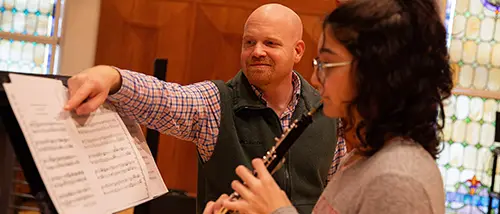
Ready to find your fearless? Schedule an audition in your area and find your place in music at SEMO.
At SEMO, we expect a lot of our music majors. As a SEMO music student, you'll audition for a place in your area. You can audition during a Music Major Day or sign up now to schedule a live audition. Online auditions are only available for students at large distances who cannot travel to campus. Interested in ensembles? For more information visit Ensembles Audtions.
Audition Dates

Admission and/or Credit Transfer
Students who are transferring to the Department of Music at SEMO should follow these steps for admission and credit transfer.
- Transfer students need to give an official transcript to their advisor before signing up for classes. Students with less than 24 credit hours must attend First STEP orientation, take UI100, and complete the sophomore review. Students with more than 24 credit hours can choose to attend Transfer Orientation or meet with a music advisor. To attend Transfer Orientation, call New Student Programs: (573) 651-5166.
- All transfer students must audition in their instrument or voice to check their skill level. The music department may accept 100- and 200-level music courses from other schools, but they will test your skills and place you in the right level.
- Transfer students must take the piano test when they start at Southeast. Students who don't pass must take Functional Piano classes. Music Education students must PASS the piano test before student teaching. Music degree students (B.A. or B.M.) must pass the piano test before their junior recital. Piano credits from other schools may count.
- Music Education students with an AA or AFA degree must complete required university courses for teacher certification (including BS, CH/GG/PH, EN140, EX390, ME222, PS103, PY222, SC105, Pedagogy 1-3, OS200, and US105 or US107).
- Transfer students with 24 or more credit hours don't need to take UI100.
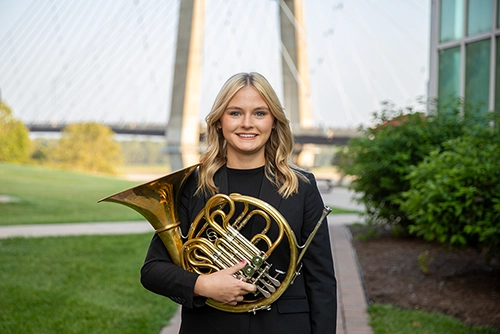

Jordan Pavelka
'26, Bachelor of Instrumental Performance
Audition Requirements
- Two pieces of contrasting style*
- Two scales of choice, two octaves required, three octaves preferred
- Sightreading
- Two pieces of contrasting style*
- Major scales required, minor scale knowledge preferred
- Full range chromatic scale
- Sightreading
- Demonstrate your best musical and technical ability on at least two or three percussion instruments (Snare Drum, 2 or 4-Mallet Keyboard Percussion, Timpani, and/or Drum Set). Complete pieces on each instrument are not required. Excerpts or short etudes/exercises will suffice.*
- Sight reading on snare drum and keyboard percussion is required.
- Drum Set: Be able to demonstrate various styles (medium and up tempo swing, bossa nova, samba, rock, funk, etc...).
*The Missouri All-State Band audition music is always a good place to start if you are not sure what to play.
- Two memorized songs.
- Most students usually use the kind of songs heard at high school solo contests. If you have one that’s in a foreign language, that’s certainly welcome but not required. For one of the selections, a non-classical song may be substituted such as a music theater selection or a religious song.*
- In addition to these prepared songs, we will also do some brief pitch-retention patterns and a couple of short sight-reading exercises.
*Please bring a copy of the printed music for the accompanist (provided).
- Demonstrate an ability to sightread a lead sheet excerpt (chords only) and sightread/learn a melody by ear or sight read a piece of fingerstyle sheet music.
- Perform two contrasting pieces with or without accompaniment. This can include contrasting solo chord melody, fingerstyle, or standard classical guitar pieces.
- For example: a jazz tune and a popular/commercial song, like Autumn Leaves and Smells Like Teen Spirit or two contrasting pop tunes like Fast Car and Enter Sandman
- One scale of choice (2 octaves preferred)
To be accepted as a B.A. Music Technology Creation Student, applicants must submit the following items:
- Three representative recordings of compositions (tracks, songs, etc.), with scores if applicable[1]
- A written or video essay explaining the creative process for one of the representative compositions. Written essays should be no more than 750 words, and video essays should be no longer than 9 minutes long.
Applicants must also demonstrate the following skills for their on-campus audition (we will provide speakers and headphones, auditioners must provide their own computer and any other hardware they wish to use for their audition):
- Basic operational knowledge for at least one of the following:
- Digital Audio Workstations (DAWs)
- Garage Band, Pro Tools, Reaper, FL Studio, Ableton, Cakewalk, etc.
- Notation software
- MuseScore, Flat.io, Finale, Dorico, Sibelius, Noteflight, etc.
- Hardware music workstations
- Drum machines, sequencers, turntables, etc.
- Digital Audio Workstations (DAWs)
Audition Requirements
You will be provided with a four-measure melody and asked to enter it as MIDI and run the MIDI to a synth VST in a DAW of your choice or enter it as standard notation in notation software of your choice or program a sequencer or other hardware music workstation to playback the provided melody using any sounds you wish.
The provided melody will be available to auditioners as standard music notation (sheet music) and it will also be played as many times as the auditioner needs for those who do not yet read standard notation proficiently.
You will then be asked to create rhythmic accompaniment for the four-measure melody in a DAW, notation software, or hardware music workstation. The rhythmic accompaniment must contain at least two distinct percussive sounds, such as snare and kick, claves and 808 bass drum, shattering glass and foot stomps, timpani and gong, etc.
You will have no more than 10 minutes to complete this task—please be sure to have your device(s) booted up and ready for use before your audition time. One or more members of the panel will observe you and your device(s) as you work to get a sense of your skill level.
View a sample auditionCompositions can include works in any style, and styles such as EDM, hip-hop, etc., are often not notated.
Take the Next Step
Contact Us
Phone
Location
Mailing Address
Cape Girardeau, MO 63701