
Space Week



Join SEMO November 3-7 for Space Week—a campus and community celebration of astronomy, exploration, and the science that connects us to the cosmos.
From planets and stars to galaxies and beyond, Space Week invites the community to look up, discover, and experience the wonder of space through engaging talks, stargazing sessions, and interactive activities. This Space Week will be the first with the new Vollink Family Observatory installed on SEMO's campus spring 2025.
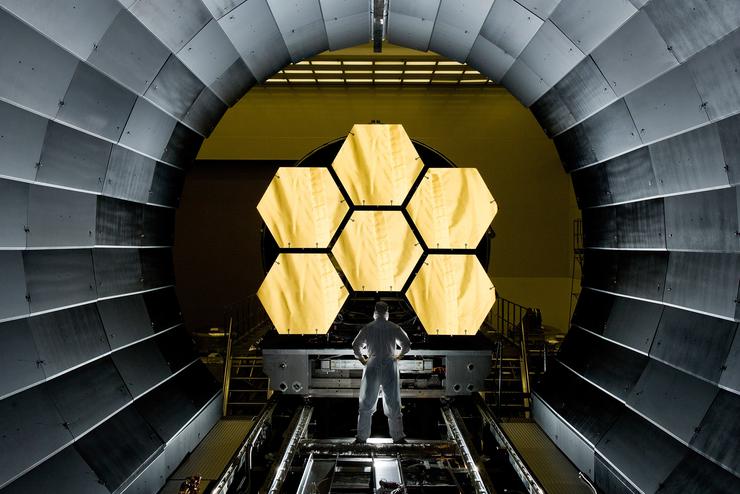
James Webb Space Telescope
Schedule of Events
Monday, November 2, 2026
Space Week Kickoff & Movie with a Chemist: Armageddon
- Time: 6:00–9:00 p.m.
- Location: Johnson Hall, Room 200
- Presenter: Dr. Rachel Morgan Theall
- Film: Armageddon (1998), rated PG-13
- Additional Sponsor: American Chemical Society, Southern Illinois Local Section
The film follows a team recruited by NASA to prevent a catastrophic asteroid impact on Earth. The screening provides an opportunity to explore the science and chemistry of asteroids while enjoying a space-themed movie.
The kickoff, discussion, and movie screening are expected to last approximately three hours.
Opening Welcome
The kickoff is expected to include a brief welcome from some or all of the following organizers:
- Dr. Joseph Murphy
- Dr. Peggy Hill
- Ms. Christina Adair
- Ms. Pamela Mills
Additional Information
The screening is free, and popcorn will be provided. The American Chemical Society, Southern Illinois Local Section, should be acknowledged.
Wednesday, November 4 , 2026
Asteroid Strike: The Day the Dinosaurs Died
- Time: 6:00–8:00 p.m.
- Location: Dempster Hall, Room 125
- Presenter: Pamela A. Mills
- Affiliation: Southeast Missouri State University
Presenter Biography
Pamela A. Mills is a Southeast Missouri State University alumna and full-time Earth Science instructor in the Department of Chemistry and Mathematics. She previously taught in public schools before joining the university.
Mills sponsors the Southeast Missouri State University Astronomy Club and is a founding member of AstroSEMO. She also sponsors the university's Geoscience Club.
Each summer, Mills organizes a weeklong paleontology field school for SEMO students in the badlands of Montana. Students collect dinosaur bones that are subsequently cleaned, prepared, and studied. Several of the 67-million-year-old dinosaur fossils discovered by SEMO students are displayed at the Crisp Museum on the Southeast Missouri State University River Campus.
Thursday, November 5, 2026
Space Trivia Night
- Time: 5:00–6:00 p.m.
- Location: Dempster Hall, Room 125
- Host: SEMO Astronomy Club
- Prizes: Provided by Dr. Joseph Murphy
Put your knowledge of astronomy and space exploration to the test during Space Trivia Night, hosted by the SEMO Astronomy Club!
Participants will compete individually in a fun, space-themed trivia competition, with prizes available for winners.
No advance registration is required, and participation is free and open to everyone.
Night Sky Observation
- Time: 6:00–8:00 p.m.
- Location: Vollink Family Observatory, Show Me Drive, near the Show Me Center
Join us at the Vollink Family Observatory for an evening of night sky observation. Visitors will have the opportunity to observe celestial objects through telescopes, weather permitting. \
The observatory will open at 6:00 p.m. The event is free and open to the public.
Visitor Information
The observatory is located on Show Me Drive, near the Show Me Center.
Observing activities are dependent on suitable weather conditions. Weather-related cancellations will be announced on the Department of Chemistry and Physics Facebook page.
Friday, November 6, 2026
Hunting for Planets in the Glare of Distant Stars
- Time: 6:00–7:15 p.m.
- Location: Dempster Hall, Room 125
- Presenter: Dr. Samantha Hasler
- Affiliation: Space Telescope Science Institute, Maryland
- Presentation Format: Remote speaker, streamed live to an in-person audience
How do we find planets orbiting distant stars, and what does it take to see them directly? NASA's Nancy Grace Roman Space Telescope (Roman) is designed to transform our view of the universe, surveying vast regions of the sky to investigate some of astronomy's biggest questions.
In this talk, we will explore Roman's mission, its journey into space, and the discoveries it could enable. We will take a close look at Roman's Coronagraph Instrument, an innovative camera designed to block the blinding glare of distant stars to reveal the faint light of orbiting planets.
By studying this light, astronomers can begin to uncover clues about the properties and atmospheres of worlds beyond our Solar System. Roman's Coronagraph will pave the way for future telescopes that may one day image Earth-like planets and search for signs of life.
For the first time, Roman is opening a new window into distant worlds similar to those in our own Solar System, and bringing us closer to answering one of humanity's oldest questions: Are we alone?
Presenter Biography — Provided by Presenter
Dr. Samantha Hasler is a postdoctoral research associate at the Space Telescope Science Institute in Maryland, where she works with NASA's Nancy Grace Roman Space Telescope Coronagraph Instrument team. Her research focuses on directly imaging planets beyond our Solar System (“exoplanets”) and developing the tools and technologies needed to study their atmospheres.
She earned her B.S. in Physics from Southeast Missouri State University before completing her Ph.D. at the Massachusetts Institute of Technology (MIT).
Her work spans the study of distant exoplanets and our own Solar System objects, which offer valuable insights into worlds around other stars.
Through her research with the Roman Space Telescope, Dr. Hasler contributes to advancing the capabilities that will enable future telescopes to search for Earth-like planets around other stars and search for potential signs of life.
Presentation Format and Logistics
Dr. Hasler will participate remotely. The presentation will be streamed live for an in-person audience gathered in Dempster Hall, Room 125.
The planned schedule allows approximately 60 minutes for the presentation, followed by 15 minutes for audience questions.
Phone
Location
Office
Mailing Address
Cape Girardeau, MO 63701