A Foundation for Excellence
SEMO launched Missouri’s first bachelor’s degree in cybersecurity in 2011 and added a master’s degree in 2019. That year, the University also approved an Institute for Cybersecurity to advance education, research, and service, connecting academic expertise with business and industry needs. External recognition has accompanied that growth. In 2019, the National Security Agency and U.S. Department of Homeland Security designated SEMO a National Center of Academic Excellence in Cyber Defense Education. The University’s cyber defense designation was renewed in 2024 through the 2029 academic year. SEMO’s bachelor’s degree in cybersecurity also holds ABET accreditation, providing another external measure of the program’s academic quality. The designation provides access to student scholarships, internship and employment opportunities through the National Centers of Academic Excellence in Cybersecurity network, along with faculty development and federal grant opportunities.
Built for Practice
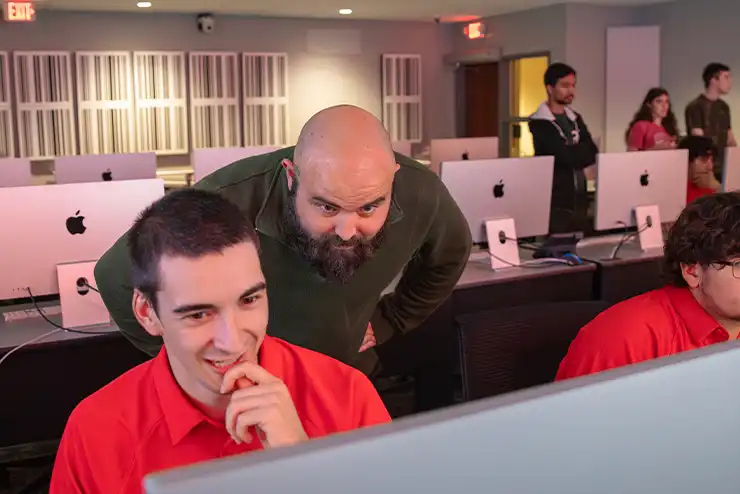
In Dempster Hall, the Charles Stamp Cyber Command Center provides a setting for students to practice responding to cybersecurity incidents. A $1 million gift from Charles Stamp, a 1971 SEMO graduate, supported its construction. The facility, in collaboration with IBM, includes a 27-foot display wall, an observation room, and dedicated servers. It was designed to support realistic breach scenarios, allowing participants to practice response and recovery, identify vulnerabilities, and strengthen security. Its workstation layout accommodates 26 trainees and a session director. Individual computer screens can be shared on the room’s video walls, allowing participants to examine the same information together. Cameras, microphones, and videoconferencing equipment support communication with remote participants, while an adjoining observation room provides another view of the exercise. The Cyber Range complements that space. Cyber Defense Club president Logan Schultz describes it as a student-run computing environment with faculty oversight. Students help maintain its systems, provide computing resources for research, and build simulated corporate networks for team training. That responsibility gives students experience supporting infrastructure other people depend on. They must understand how systems work, troubleshoot problems, and keep resources available.
Tested Under Pressure
Competition provides another measure of students’ preparation. SEMO earned its 12th Missouri Collegiate Cyber Defense Competition championship in 2025. In 2026, the team placed third in Missouri and second in the Midwest wildcard round, securing another regional berth. The competition requires students to defend networks, respond to threats, and maintain business operations. Technical skills matter, but so do communication, judgment, and the ability to keep working when something goes wrong. As club president and a team co-captain, Schultz helps organize training. He deliberately misconfigures systems so teammates can practice identifying and repairing problems. During competition, captains help decide whether to continue troubleshooting or spend points to reset a system. The cybersecurity club welcomes students regardless of major or experience level. That creates a place for newcomers to ask questions, develop skills, and learn from more experienced students.
Experience with a Purpose
The connection between instruction and practice carries into professional work. Schultz has moved from network operations into cybersecurity through an internship with Leidos, a Fortune 500 technology and defense company. He hopes to pursue incident response, investigating intrusions and removing threats from compromised systems. Fellow team co-captain Malachi Pruitt has applied his skills as a pre-apprentice and team lead with the Missouri Cybersecurity Center of Excellence. His responsibilities include detecting, quarantining, and mitigating ransomware threats and helping protect police department devices containing sensitive law enforcement information. At SEMO, he also works as a learning assistant in networking, computer science and cybersecurity. “Having a mix of both is really important,” Pruitt said of classroom instruction and practical experience.
A Resource for the Region
SEMO’s cybersecurity work also reaches people outside its degree programs. In 2023, the University hosted a State Cybersecurity Education Innovation Summit with 85 participants, bringing educators together to discuss expanding cybersecurity learning opportunities. More recently, the Division of Workforce and Economic Development facilitated a Basics of Cyber Awareness program for local elected officials and community stakeholders. Presented in part by a SEMO student, the program helped participants understand how to protect their personal and business information. “Rural America is not immune to the threat of cyberattacks and fraudulent activity,” said Dan Presson, assistant vice president for economic and workforce development. “Having a center like this in our region is incredibly important in a time when scams are getting more and more sophisticated.” These experiences connect student learning with regional needs, giving students opportunities to share their knowledge while helping community members protect the information they depend on.