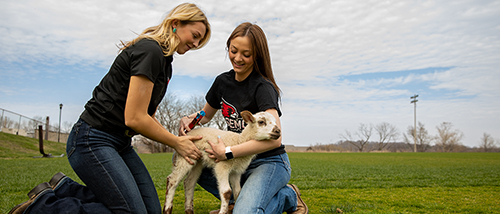
Begin your journey to veterinary school: find your fearless.
The pre-vet program at SEMO is designed for students who intend to go on to a veterinary medicine school and receive their Doctor of Veterinary Medicine (DVM) degree. You do not necessarily need a bachelor’s degree to be admitted to a veterinary medicine program. Rather, students need to meet the requirements before applying. That’s why this is a preprofessional program.
Most of our students in the pre-vet program still obtain a Bachelor of Science degree. Recommended majors that are compatible with meeting the entrance requirements are Agribusiness: Animal Science or Chemistry. If you major in Animal Science, the program is designed to substitute the classes that do not count toward finishing the pre-vet program, thus saving you time to graduation.
The pre-vet program outlined is tailored for students who will go to the University of Missouri College of Veterinary Medicine or University of Illinois College of Veterinary Medicine. Students who wish to go to other schools will follow a similar program but may need to fill a few other requirements. Students work closely with their pre-vet advisor in the Department of Agriculture to ensure they meet the requirements and are competitive when they apply.
Where Bold Ideas Take Shape in Your Pre-Vet Program
- Faculty-mentored research and guidance will help you develop the professional skills needed for success in advanced study in graduate and professional programs.
- Completing a degree while at SEMO prepares students for entering the workforce immediately in various capacities of the animal and agriculture fields.
- 100% of SEMO programs offer real-world experience. Pre-veterinary medicine students shadow veterinarians.
- Pre-veterinary medicine students take a variety of science classes, including biology, chemistry and physics classes, as well as courses in Animal Science which help them gain animal experience. Helpful classes include Companion Animals, Domestic Animal Anatomy and Physiology, Animal Nutrition, Animal Handling and Animal Reproduction.
- In 2020, our pre-veterinary medicine students had a 90% acceptance rate into just 30 vet programs across the country.
What Can You Do with a Pre-Vet Bachelor's Degree?
The pre-veterinary medicine program is designed for students who intend to go on to a veterinary medicine school and receive their DVM degree. One does not necessarily need a bachelor’s degree to be admitted to a veterinary medicine program. Rather, students need to meet the requirements before applying; hence, it is a pre-professional program.
Pre-Vet Program Career Opportunities
- veterinarian
- veterinarian technician
- veterinary hospital manager
- animal research technician
- food safety inspector