
When Dr. Laura Hatcher first walked across campus at Southeast Missouri State University, she was there to conduct research in Special Collections at Kent Library, not to apply for a job. But within minutes, she could see herself staying.
“As we were walking through campus, I remember saying, ‘Wow, I could really work here,’” Hatcher said. “A couple of years later, SEMO posted a position that looked like it was written for me.”
Today, Hatcher is a professor of the Department of Anthropology, History and Political Science, a department she says stood out from the very beginning because of its people.
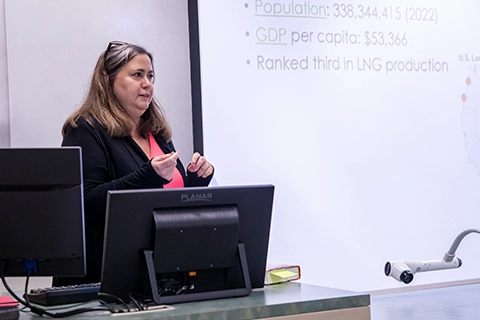 During her campus interview, she was asked to teach a class on Congress, slightly outside her usual focus on the judiciary. What stood out wasn’t the subject matter; it was the students.
“They were so kind,” she said. “They were trying to help this complete stranger who had interrupted their class for the day. I had never been at a place where students were actively trying to help a job candidate succeed.”
That culture of respect and intellectual curiosity remains central to her teaching philosophy. In a discipline often shaped by debate and disagreement, she prioritizes creating a space where students from all political perspectives can learn from one another.
“We have students from all political ideologies in the classroom who are friends,” Hatcher said. “We expect them to work together, study together and engage respectfully. Leadership starts with listening.”
At its core, Hatcher describes political science as the study what makes government work, a question philosophers and policymakers have wrestled with for thousands of years.
“It’s both philosophical and practical,” she said. “We look at what makes a good federal government, what good congressional behavior looks like, what defines a good judicial branch. But we also study state and local government because that’s where many of our students will serve.”
Tell me More about Political Science
As a regional comprehensive university, SEMO’s program emphasizes applied learning alongside theory. Students do more at SEMO than discuss policy. They also practice it, drafting legislation, amending mock constitutions, analyzing polling data, and conducting legal and legislative research that mirrors real-world work.
“Our students read a lot. They write a lot,” Hatcher said. “Political science students learn how to write, and they learn how to think.”
That preparation opens doors from law school and public policy graduate programs to city management, nonprofit leadership and regulatory and government roles.
For Hatcher, some of the most meaningful moments happen when students recognize their own growth. At the undergraduate level, she sees it when students realize they can read and understand a Supreme Court case on their own and then confidently discuss it with a guest speaker during Constitution Day events.
“At some point, they think, ‘I’m having a real conversation, and I actually know what I’m talking about,’” she said. “That’s always fun to watch.”
At the graduate level, she recalls a Division I athlete sidelined by injury and uncertain about his future. Through coursework and a city government internship, he discovered a passion for public service and a future as a city manager.
“Once he figured out where to apply his skills, he just blossomed,” Hatcher said. “Not just as a student, but as a human being.”
Hatcher credits much of that transformation to the department’s intentional and individualized advising. Faculty meet with students for extended advising appointments.
“It’s not a 15-minute meeting where we hand you a schedule and send you on your way,” she said. “We sit down. We talk. If you’re nervous, tell us what you’re nervous about.”
In a world that feels increasingly polarized and fast-moving, Hatcher teaches political science students to slow down, think critically and listen carefully before responding.
Her goal is to prepare students to contribute meaningfully to their communities.
“I hope they leave here understanding that individuals matter,” Hatcher said. “Whatever their ambitions are, they need to make a contribution. It doesn’t have to be huge. Start small. Think big. But recognize that one person can make a difference.”
In Hatcher’s classroom that belief isn’t abstract. It’s the starting point.
You can start today at semo.edu/polisci.