

When Hemant Upadhyay enrolled in the Southeast Missouri State University (SEMO) Master of Science in Cybersecurity program in the spring of 2025, he wasn’t new to the field. By that point, he’d earned a bachelor’s in cloud computing and big data and landed a job at a major software as a service provider in the telecommunications sector.
“I served as a presales engineer and a custom solutions developer for about nine months,” Upadhyay says. “After that, I transitioned into a cybersecurity role. I started with some of the smaller tasks, like audit assessments.”
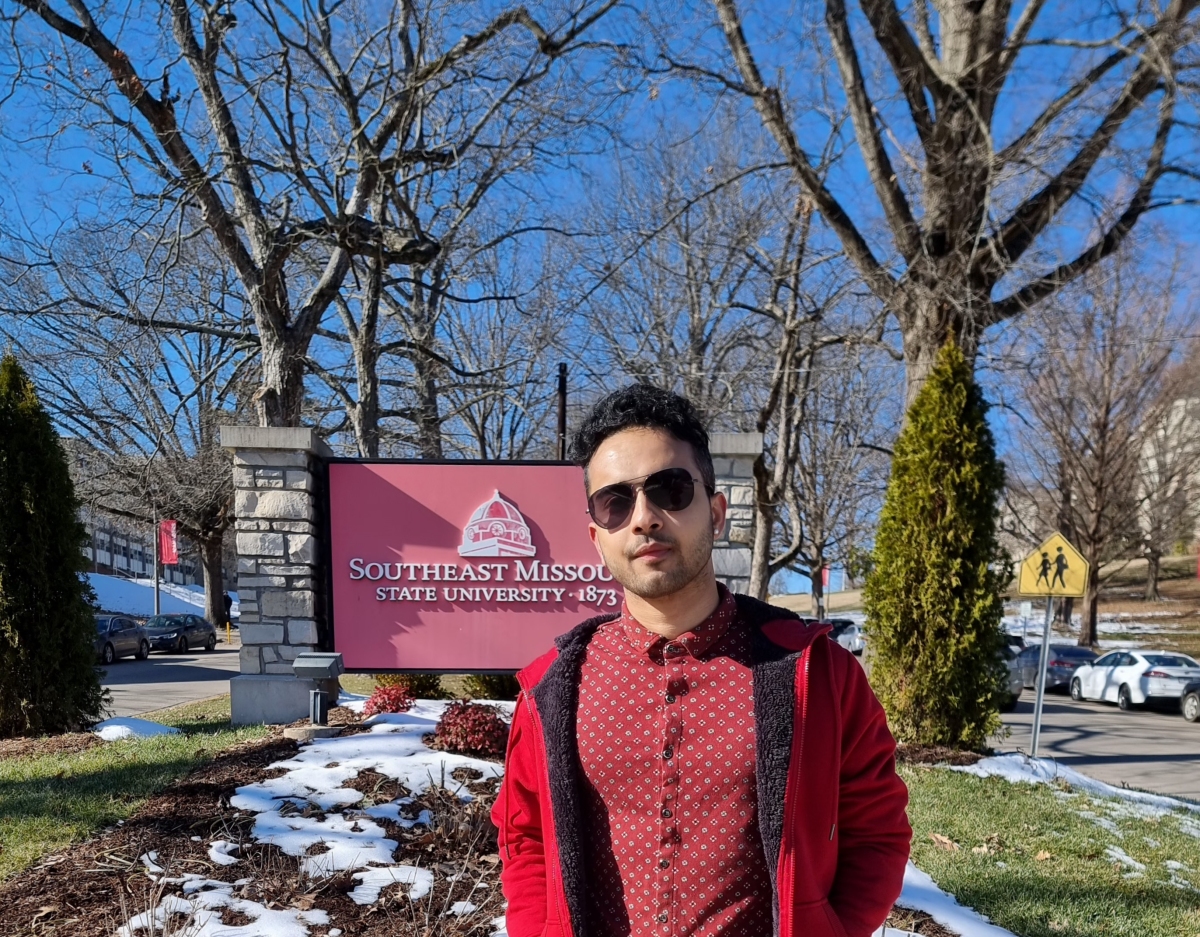
Upadhyay thrived in this role. By the end of his time with this employer, he was overseeing security compliance, governance and the legal aspects of cybersecurity for clients in the entire south Asian region. Many of those clients were financial institutions and healthcare organizations, which meant that keeping them secure was no simple task.
Despite this experience, Upadhyay knew that if he was going to take his cybersecurity career to the next level, he needed more technical skills and knowledge. Earning a master’s would certainly help him accomplish that. But Upadhyay is from Kathmandu, Nepal. What brought him all the way to SEMO in Cape Girardeau, Missouri?
Finding the Perfect Cybersecurity Program
After taking some time off to attend the FIFA World Cup in Qatar, Upadhyay got serious about finding the perfect master’s program. He started by narrowing down the possibilities to programs located in what he considers the best place to get such an education: America.
“I started scouring, and it came down to three universities,” he says. “I will just put it this way: Affordability was a very important factor. SEMO offers a really good, affordable education.”
Upadhyay also was looking for a program that would allow him to bridge the theory he would be learning about in the classroom with hands-on learning opportunities. After finding out about SEMO’s Charles Stamp Cyber Command Center and its various cybersecurity competition and club opportunities, Upadhyay knew the school could provide him with that.
“It was a perfect balance, with the quality of education in general, the opportunity for hands-on exposure with all these different competition and club environments, and also the affordability,” he says. “Those were the three reasons I ended up at SEMO.”
Very quickly, though, he learned that was just the beginning.
A Hands-On, Skills-Focused Curriculum
As of spring 2026, Upadhyay has completed most of his core cybersecurity classes, such as Intro to Cybersecurity and Information Security and Assurances. He’s also taken elective classes on machine learning and legal compliance, which are only two of the many classes SEMO students can customize their schedules with.
“We have a hands-on lab for every topic, and it is associated with some sort of tool or technology or technique,” Upadhyay says about the curriculum. “You get a lot of exposure to how things actually work.”
His studies have helped him expand his industry certifications, including earning the Cybersecurity Analyst+ (CySA+) credential from CompTIA.
Now Upadhyay is combining everything he’s learned so far in his thesis project. His project is focused on using blockchain smart contracts to facilitate access control for devices on a network. The idea, Upadhyay says, is to be able to ensure that the data about the network processes stays encrypted but also accessible to stakeholders and tamper-proof.
“Everyone keeps a copy of everything,” he explains. “It’s about transparency and auditability.”
Reshmi Mitra, PhD, an associate professor of computer science at SEMO, is Upadhyay’s thesis advisor. The two meet regularly so that Upadhyay can get valuable technical guidance as well as encouragement.
“We have constant conversation and idea sharing about the direction of the thesis,” Upadhyay says. “She’s also my mentor and [teaching assistant] supervisor, not just a thesis advisor. But, in general, for everything, she’s been awesome. It’s been a great experience working with her. We’ve been fairly open about feedback — constructive criticism as well as positives — and she’s very good at delivering both.”
Invaluable Extracurriculars
While Upadhyay has learned a lot through his classes, labs and thesis work with Mitra, he’s also gotten involved in many of SEMO’s cybersecurity-focused extracurricular activities.
“I’m doing Mitra's eCTF competition with Dr. [George] Li right now,” Upadhyay says, referencing the national Embedded Capture the Flag competition that has teams design, secure and attack systems. “I’ve learned so much about embedded, or IoT, technology through that competition.”
He is also an officer in SEMO’s Cyber Defense and Ethical Hacking clubs and a participant in Collegiate Cyber Defense Competitions (CCDCs).
In the CCDCs, the Blue Teams are placed in a high-pressure, real-world enterprise network environment where they must defend their systems against a live Red Team of professional attackers. The Blue Teams must identify and mitigate threats while also maintaining critical business operations during a limited eight-hour time window. They balance security with usability while completing tasks such as configuring services (e.g., printers and servers), responding to executive or customer requests, and ensuring uptime for essential infrastructure.
“That was one of my favorite things I’ve experienced,” Upadhyay says. “I would just recommend, if anyone wants to start into cybersecurity, they start with some cyber defense competitions. It’s a perspective-changing experience.”
Strengthening SEMO’s Cybersecurity Community
In between his classes, thesis work and extracurricular activities, Upadhyay still finds enough time to give back to the community he’s learned so much from. He’s a teaching assistant (TA) for Mitra and Mario Garcia, PhD, a professor and the director of SEMO’s Institute of Cybersecurity.
“I help with grading and take over classes when the professors are unavailable,” Upadhyay says of this role. “I support professors with exam proctoring or helping with course materials.”
Most exciting to Upadhyay, he is also helping his professors design new hands-on labs. He’s currently working on a lab for Mitra’s class on digital circuits. In the future, he hopes to create labs tailored to the community at large. From his perspective, basic cybersecurity skills are essential in today’s world.
“Cybersecurity has become very vast,” Upadhyay says. “It’s not just about network security anymore. Everything’s digital these days, so, in that sense, cybersecurity is security.”
SEMO: A Launching Pad for Success in Cybersecurity
Upadhyay is slated to graduate from SEMO with a Master of Science in Cybersecurity in December 2026. With that day fast approaching, he’s planning his next moves.
“I want to take my career more into fraud detection, like a security incident analyst role,” he says. “I do have a plan somewhere down the line to have my own cybersecurity firm and help contribute to the cybersecurity field in Nepal as well.”
Those are lofty goals in today’s fast-moving cybersecurity landscape. But being the highly motivated and relentlessly curious person Upadhyay is, he feels they are well within his reach. Even though he’s not quite finished with his studies, he believes SEMO has given him the tools he needs to make it all happen.
“SEMO provides the platform,” he says. “It’s a complete package with the competitions, the club environments, the classes, all the stuff that SEMO provides.”
Take the Next Step to Advance in Your Cybersecurity Career Today
While Hemant Upadhyay traveled across the globe to attend the on-campus Master of Science in Cybersecurity program at Southeast Missouri State University, SEMO also offers an online Master of Science in Cybersecurity program that makes the experience more accessible to students than ever before.
In the online program, students learn the skills they need to excel in today’s competitive cybersecurity job market in areas such as network defense, computer forensics, and clear communication. Along the way, SEMO’s experienced and student-focused faculty are there to guide, mentor, and offer their own first-hand insights to students.
“The online classes are very well structured,” Upadhyay says, explaining he’s taken Research Methods in Cybersecurity online and been a TA for multiple online classes. “They’re self-paced and very course-focused, so every module that comes up the next week builds upon the previous week, which is something I really like. You can work and study from anywhere you want, and you can do it at your own pace.”
To find out more about this program or SEMO Online’s other graduate programs in areas such as data science and applied computer science, request information today.
Recommended Readings
How to Become a Cybersecurity Consultant
Inside the Effort to Secure SEMO’s Campus
Stamp Cyber Command Center to Prepare SEMO Students and Regional Businesses for the Future of Cyber Defense