Mass Communications: Multimedia Journalism

BS On-Campus Main Campus
DEGREE TYPE

Bachelor's Degree

PROGRAM TYPE

Undergraduate

DEPARTMENT
Mass Media
APPLY NOW

Do more than watch the news. Break the stories that make a difference.

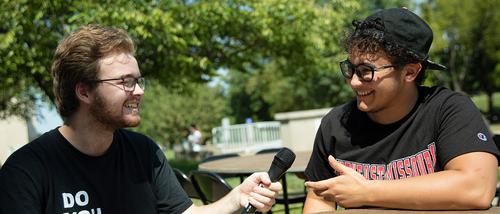
The mass communications and multimedia journalism program prepares you for all facets of journalistic storytelling – writing, design, podcasting, photography, and on- and off-screen video. Work with veteran media professionals in small-class settings. In addition, gain real-world experience working for our award-winning student media.

Learn by Leading in multimedia journalism

In your multimedia journalism courses at SEMO, you’ll gain incredible real-world learning experience in a program accredited by the Accrediting Council on Education in Journalism and Mass Communication (ACEJMC). That means our Mass Communications program is held to a high standard and is prepared to give you the best multimedia journalism education we can.

In your multimedia and journalism courses you will:

  • Learn to create dynamic news content and visuals for delivery across multiple media platforms. 
  • Build production skills while using industry-standard tools. 
  • Have opportunities to work for professional publications and local media partners. 
  • Build your portfolio while working for SEMO’s award-winning student newspaper, The Arrow. 

What Can You Do with a Multimedia Journalism Degree?

A Multimedia Journalism degree prepares you to tell stories, inform communities, and connect with audiences across a variety of platforms. As media continues to evolve, organizations need skilled communicators who can research, write, produce, and share content through digital, broadcast, social, and emerging media channels.

Career Opportunities

Multimedia journalism majors can pursue careers such as:

  • Multimedia journalist
  • Reporter
  • News producer
  • Broadcast journalist
  • Digital content creator
  • Social media strategist
  • Content producer
  • Communications specialist
  • Public information officer
  • Podcast producer
  • Video producer
  • Audience engagement specialist

Where Can You Work with a degree in multimedia journalism?

Multimedia Journalism graduates can find job opportunities with:

  • News organizations
  • Television and radio stations
  • Digital media companies
  • Sports organizations
  • Marketing and communications agencies
  • Government agencies
  • Nonprofit organizations
  • Corporate communications teams

Specific Internship and Employment placements of Recent Graduates

Explore a few of the places that have hired our SEMO multimedia journalism majors, either through internships or full time employement. 
  • Anheuser-Busch
  • Ansira
  • AT&T
  • CNN (Atlanta)
  • ESPN
  • FleishmanHillard
  • Golin-Harris
  • Hoffman Media LLC
  • KFVS
  • KSDK-TV (St. Louis); KMOV-TV (St. Louis)
  • MEC
  • Nestle-Purina
  • Osborn Barr
  • Red Letter Communications, Inc.
  • Saint Francis Medical Center
  • St. Louis Cardinals
  • St. Louis Post-Dispatch
  • Southeast Missourian
  • Turner BroadcastingTurner Sports
  • Universal Studios (Los Angeles)
  • Washington Post

Request Info

We'd love to help you learn more about SEMO! Tell us how we can get in touch.

Loading...

Multimedia Journalism Degree Map

Explore the courses you'll need to complete your degree.

Outcomes & Careers

The Knowledge to Fuel Fearless Futures

As a multimedia journalism major, learn how to work in today’s ever changing media industry. Complete a minimum of 120 credit hours to complete this degree, including the general education requirements and at least 45 senior division hours. A minor is required.

45 Hour Major – No minor required

Required Core Courses
A grade of ‘C’ or better is required in each core course except MC001 which is a credit/no credit course.
  • MC001 Exit Interview (0)
  • MC101 Media and Society (3)
  • MC221 Digital Media Production (3)
  • MC301 Media Analytics (3)
  • MC304 Media Diversity (3)
  • MC382 Media History (3)
  • MC401 Media Law (3)
  • MCxxx Elective (3)
  • MCxxx Elective (3)
Required Option Courses
A grade of ‘C’ or better is required in each option course except MC002, which is a credit/no credit course.
  • MC002 Arrow Lab (0)
  • MC320 Media News (3)
  • MC327 Media Visual Production (3)
  • MC351 Basic TV & Film Production (3)
  • MC352 Video Post-production (3)
  • MC363 Sports Broadcast Production (3)
  • MC421 Media Storytelling (3)
  • MC429 Media Management (3)
Required Support Course – choose 3 hours:
A grade of ‘C’ or better is required in each support course.
  • MA123 Mathematical Reasoning and Modeling (3)
  • MA155 Statistical Reasoning (3)

Some requirements may be fulfilled by coursework in major program.

  • Social and Behavioral Sciences – 6 hours
  • Constitution Requirement – 3 hours
  • Written Communication – 6 hours
  • Oral Communication – 3 hours
  • Natural Sciences – 7 hours (from two disciplines, one to include a lab)
  • Mathematics – 3 hours
  • Humanities & Fine Arts – 9 hours (from at least two disciplines)
  • Additional requirements – 5 hours (to include UI100 for native students)
  • Civics examination

Any student wishing to be formally admitted into the Advertising, Multimedia Journalism, Public
Relations, or Television & Film options within the Department of Mass Media must complete the
Declaration of Major form and meet the following criteria:
  • Completion of a minimum 15-semester hours at Southeast Missouri State University or transferred from an accredited college or university.
  • Attain a minimum cumulative grade point average (GPA) of 2.0 on a 4.0 scale.
  • 3. Completion of EN 100 or EN 140 with a minimum grade of 'C.'

First Year 

Fall Semester (16 Hours) 
  • UI100 (1) 
  • EN100 (3) 
  • MA123 or MA155 (3) 
  • MC101 (3) 
  • General Education (3) 
  • General Education (3) 
Spring Semester (15 Hours) 
  • MC221 (3) 
  • General Education (3) 
  • General Education (3) 
  • General Education (3) 
  • General Education (3) 

Milestone: Admission to the Mass Communication program after the second semester. 

Second Year 

Fall Semester (15 Hours) 
  • MC331 (3) 
  • General Education (3) 
  • General Education (3) 
  • General Education (3) 
  • General Education (3) 
Spring Semester (15 Hours) 
  • MC002 (0) 
  • MC301 (3) 
  • MC320 (3) 
  • MC327 (3)
  • General Education (3) 
  • Elective (3) 

Milestone: Maintain a 2.0 cumulative GPA and 2.25 major GPA. 

Third Year 

Fall Semester (15 Hours) 
  • MC002 (0) 
  • MC304 (3) 
  • MC351(3) 
  • MC352 (3)
  • Elective (3) 
  • Elective (3) 
Spring Semester (15 Hours) 
  • MC002 (0)
  • MC382 (3) 
  • MC421 (3) 
  • MC Elective (3) 
  • Elective (3) 
  • Elective (3) 

Milestone: Maintain a 2.0 cumulative GPA and 2.25 major GPA. 

Fourth Year 

Fall Semester (15 Hours) 
  • MC002 (0)
  • MC401 (3) 
  • MC429 (3) 
  • Elective (3) 
  • Elective (3) 
  • Elective (3) 
Spring Semester (14 Hours) 
  • MC001 (0) 
  • MC Elective (3)
  • Elective (3) 
  • Elective (3) 
  • Elective (3) 
  • Elective (2) 

Milestone: Maintain a 2.0 cumulative GPA and 2.25 major GPA. 

A “Milestone” signifies a significant stage for a student in the completion of a degree.

“Critical Courses” are italicized and bolded. Data shows that students who have completed this course in the first two years and have earned the noted grade are most likely to complete this program of study.

Get Funding for Your Education

Missouri’s opened the door to a more educated workforce. We want to help you walk through it. If you’re an adult learner and a Missouri resident returning to college, learn about the Fast Track Workforce Incentive Grant. It’s a statewide financial aid program that can be used to pursue a certificate, degree or industry-recognized credential in a high need area in Missouri. This major is eligible for the Fast Track grant.
Logo for Fast Track Workforce Incentive Grant

KRCU

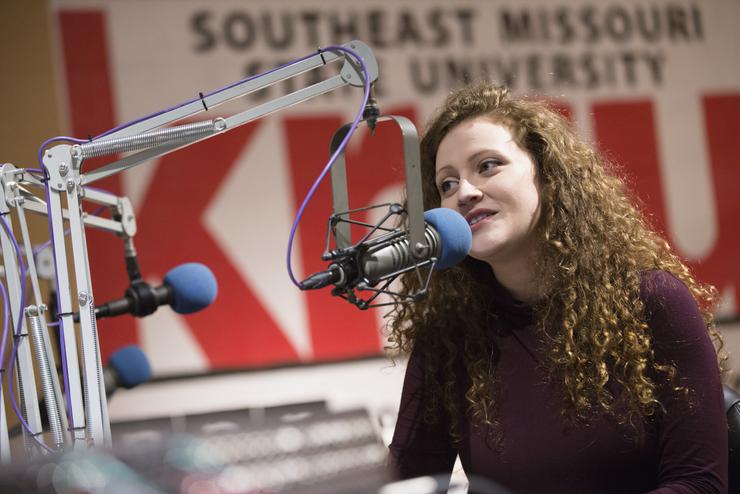
Mass Media students have the opportunity to gain valuable experience at KRCU, Southeast Missouri State University's NPR News and Classical Music public radio station. It includes three stations that provide in-depth news and quality music programming to over 350,000 people in its service region.
Lindsey Grojean works on-air at KRCU.

Accreditations

Become a Redhawk.

Do more than dream about the future. Take the first steps to make it all happen.

Multimedia Journalism Mass Communications Program FAQ's

Explore frequently asked questions about the multimedia journalism degree in the mass communications program.

Multimedia Journalism graduates pursue careers in:

  • news
  • media
  • communications
  • content creation

Common job titles include:

  • multimedia journalist
  • reporter
  • news producer
  • digital content creator
  • social media manager
  • communications specialist
  • podcast producer
  • video producer
  • public information officer

Successful multimedia journalists combine strong communication skills with digital storytelling expertise. Key skills include:

  • writing
  • interviewing
  • research
  • video production
  • photography
  • social media management
  • content creation
  • critical thinking
  • audience engagement
Mass communications students learn how to create and share messages across multiple platforms and audiences. Coursework typically develops skills in storytelling, media production, strategic communication, digital content creation, visual communication, public speaking, collaboration, and media ethics.
Scholarship opportunities vary by institution and program. At SEMO, students may qualify for university scholarships, departmental awards, and financial aid opportunities that help make earning a Multimedia Journalism degree more affordable! Explore available scholarship options today.

Location

Office

Grauel Building, 016

Mailing Address

One University Plaza, MS 2775
Cape Girardeau, MO 63701